In the name of Allah, the Most Gracious, the Most Compassionate.
Surah Al Ikhlas was revealed in Makkah.
Ubay ibn Ka’ab (radhiyallahu anha) said that the idolaters said to the Prophet, “O Muhammad! Tell us the lineage of your Lord.” So Allah revealed, “Say : He is Allah, who is One. Allah is As-Samad. He begets not, nor was He begotten. And there is none compared to Him.” [Ahmed/Tirmithi]
بِسْمِ اللهِ الرَّحْمٰنِ الرَّحِيمِ
(قُلْ هُوَ اللهُ اَحَدٌ (١
“Say : Allah is Ahad.”
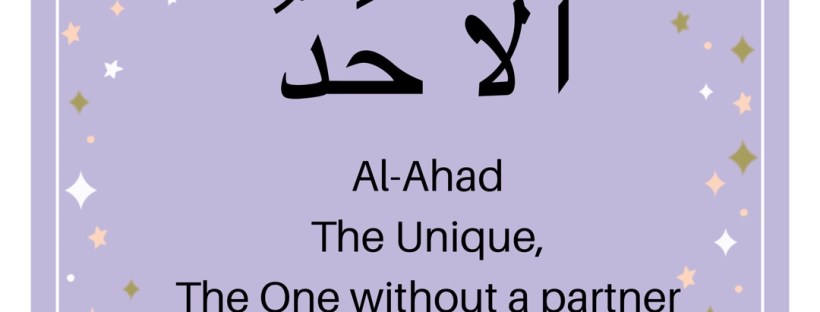
Ahad means unique. This word is more emphatic than wahid (the only one). Ahad negates partnership in every sense.
(اَللهُ الصَّمَدُ (٢
“Allah is As-Samad, The Self-Sufficient.”
As-Samad means the eternally besought of all, The Self-Sufficient. All creation turn to Him and they depend on Him, to fulfill their needs. On the other hand, all created beings have needs and are dependent on others to fulfill their needs. Allah is not in need of any of His creation in any way, as nothing they can do can better or benefit His already perfect state. This attribute of self-sufficiency invites the believers to reflect on the purpose and the goals of their worship. Most people worship as if they are doing God a favor. The purpose of human creation is to worship Allah because all human beings have a need to worship Him. He has no need for or from them. Human beings need to worship and glorify God because obedience to divine law is the key to their success in both this life and the next.
(لَمْ يَلِدْ وَلَمْ يُو لَدْ (٣
“He does not give birth nor He was born.”
This is called Tawheed of purity. Nothing came out of Him nor He come out of anything. This verse describes another aspect of Allah’s Unique Oneness. False religions generally represent God in human terms by either giving Him human characteristics and or human form. This verse deals primarily with two distinct characteristics of human beings and other living creatures in general: coming into existence by being born and procreating by giving birth.
“Nor was He born” rejects the concept that Jesus was God, because he was born. For God to be born, He must first have not existed, which contradicts the basic unique divine attribute of eternal existence.
(وَلَمْ يَكُن لَّهُ كُفُوًا اءَحَدٌ (٤
“And there is none comparable to Him.”
He has no equal. Allah closes the chapter with a restatement of the opening verse. If God is unique, nothing can be equal to Him. If nothing is equal to Him, then He alone is unique. If He alone is Self-Sufficient and all creation is in need of Him, nothing in creation can be equal to Him. If He does not bear offspring, nor did anyone or anything give birth to Him, nothing or no one can be equal to Him as every created being came into existence after a period of non-existence. Every created being has something similar to it, called its pair, or something resembling it, called its equal. If the Creator were from one or other of these species He would have an equal and a similitude.
言え:「かれはアッラー(神)、唯一なる御方。」(1)
「アッラーフッ=サマド(アッラーは、あらゆる被造物が必要とする自存する主」(2)
「御産みなさらないし、御産れになられたのではない。」(3)
「かれに比べ得る、何ものもない。」(4)
解釈
(1)「言え」とは、私たちが信じ、認識する「かれはアッラー(神)、唯一なる御方」という明白な主張で、唯一性がかれのみに限定され、かれのみが完全性、そして最も美しい御名と究極の性質を有していることを意味します。かれは唯一無比かつ無類の存在です。
(2)「アッラーフッ=サマド」 アッラーは、あらゆる被造物が必要としている自存する主です。天界・下界のあらゆる生物は、かれをこの上なく必要とします。アッラーはすべての性質において完璧であり、完全なる知識を有する全知者であり、最も完全な寛大さを持つ寛大なる御方であり、完全なる慈悲を持つ最も慈悲深き御方であるため、それらは自らの必要性をかれに訴え、自らの諸事の解決を願います。
(3)「御産みなさらないし、御産れになられたのではない」のは、一切の必要性から解放された、かれの完全無欠性によるものです。
(4)「かれに比べ得る、何ものもない」のは、かれの御名と性質、そしてかれの行いを含めたすべてのものです。かれはあらゆる不完全なものから遠く隔たれた御方なのです。
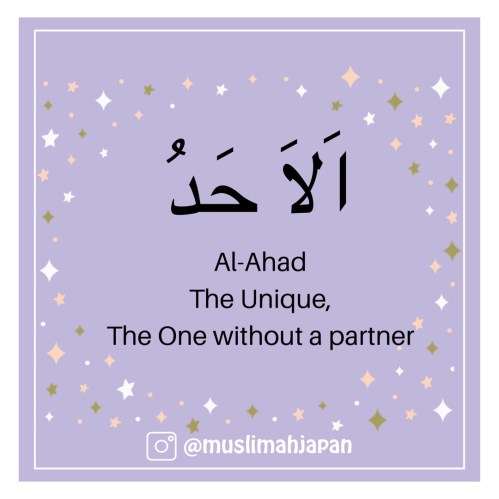
[Al Ahad, written in Arabic]
 Muslimah Living In Japan