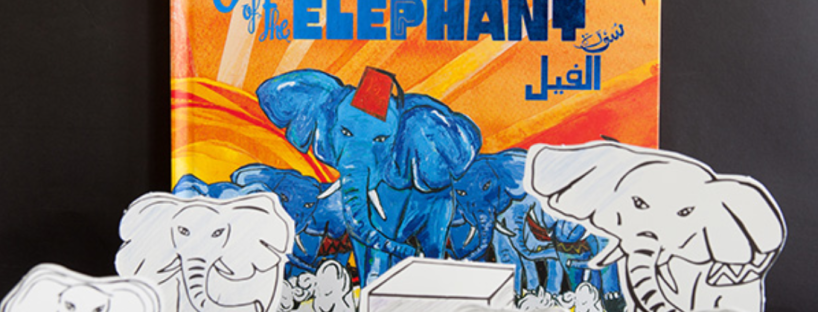
Prophet Muhammad was born 50 days after the event of the Year of the Elephant. What is the Year of the Elephant? It refers to a very famous incident that took place in the Arabian country and it demonstrates how God protected the land that was to become the focal point of the last revelation. Chapter 105 entitled The Elephant consist of five short verses, described briefly because it was an event still clear in the minds of those people in Mecca and the surrounding areas.
بِسْمِ اللهِ الرَّحْمٰنِ الرَّحِيمِ
In the name of Allah, the Entirely Merciful, the Especially Merciful.
慈悲あまねく慈愛深きアッラーの御名において。
اَلَمْ تَرَكَيْفَ فَعَلَ رَبُّكَ بِاءَصْحٰبِ الْفِيلِ
Have you not considered, [O Muhammad], how your Lord dealt with the companions of the elephant? [あなたの主が,象の仲間に,どう対処なされたか,知らなかったのか。]
اَلَمْ يَجْعَلْ كَيْدَ هُمْ فِى تَضْلِيلٍ
Did He not make their plan into misguidance?
[かれは,かれらの計略を壊滅させられたではないか]
وَاَرْسَلَ عَلَيْهِمْ طَيْرًا اءَبَا بِيلَ
And He sent against them birds in flocks,
[かれらの上に群れなす数多の鳥を遣わされ,]
تَرْمِيهِم بِحِجَا رَةٍ مِّن سِجِّيلٍ
Striking them with stones of hard clay,
[焼き土の礫を投げ付けさせて]
فَجَعَلَهُمْ كَعَصْفٍ مَّاءْ كُولِ
And He made them like eaten straw.
[食い荒らされた藁屑のようになされた。]
Various historical reports tell us that the Abyssinians had expelled the Persians from Yemen. They established their rule there under the Abyssinian governor Abrahah. He established a splendid and expensive church in his capital because he had witnessed the love and enthusiasm the Yemeni Arabs had for their Holy House at Mecca, and he hoped to entice them away from there and to his capital at Sa’na. He hoped to divert the annual pilgrimage from the Ka’bah to the new church.
Because his intention did not happen, he determined to destroy the Holy House. He set out for Mecca with a large army which included thirteen elephants, with the target of demolishing the Ka’bah. As Abrahah’s armies approached the city, God intervened. It is said that the lead elephant sat down and refused to move towards the city. The elephant trainers tried all they could to make the elephant move but he refused. When he was encouraged to move in a different direction the elephant cooperated but when turned towards Mecca he refused.
Verse 1 The Army of the Elephant
God addresses Prophet Muhammad, asking him, have you not seen how your Lord (God) dealt with the Army of the Elephant? God is asking Prophet Muhammad, don’t you remember, don’t you realise? The punishment of God is not limited to the Hereafter and this event is an example that God can inflict punishment at any time. This question also draws the reader’s attention to the incident and thus stresses its great significance.
This incident was so well known to the Arabs that the year in which it occurred came to be known as the Year of the Elephant, and they used to use it to describe various lengths of time. It was as if it was their calendar. For example they would say this thing happened in the year of the Elephant or it happened two years before the year of the Elephant. And this was also the year in which Prophet Muhammad was born.
Verse 2 Futility
Next God abbreviates the well-known story in the form of a rhetorical question. Did He (God) not cause their treacherous plan to be futile? Any plans made by the People of the Elephant were useless and incapable of achieving their desires because their plans were not God’s plans. Although they set out with a destination and an outcome in mind they were like people lost and wandering, their destination was out of reach. The Meccans were too weak to face the aggressors but God took it upon Himself to protect His Holy House. He reduced their nefarious plans to nothing.
Verses 3 – 4 Birds in Great Flocks
The Quran then brilliantly portrays how the aggressors were defeated. As the army encamped outside the area around the Ka’bah, God destroyed them with a flock of birds, which pelted them with stones of clay. Islamic historians say that the birds were of all different kinds, some never seen in that area before. In addition to this they came from every direction. Those who could remember the event described the birds as filling all of the sky, as far as they could see. The birds did not each throw one pebble; they had pebbles in their beaks and in each of their claws and they fell like rain, one after the other. The pebbles were thrown from such a height that it is said that they went straight through their skulls.
Verse 5 Devastation
Abrahah’s army was totally destroyed on its march, as being devoured like dry leaves. In other translations they are described as looking like the windblown died straw that animals chew on. It was totally unexpected and miraculous rescue to the distressed people of Mecca. Islamic historians tell us that Abrahah survived the attack and fled back to Sa’na. By the time he arrived his body looked as if it was diseased, with lots of wounds. Normally when an army is defeated they make plans to avenge that defeat but the condition of Abrahah meant that they were severely afraid to return to the area.
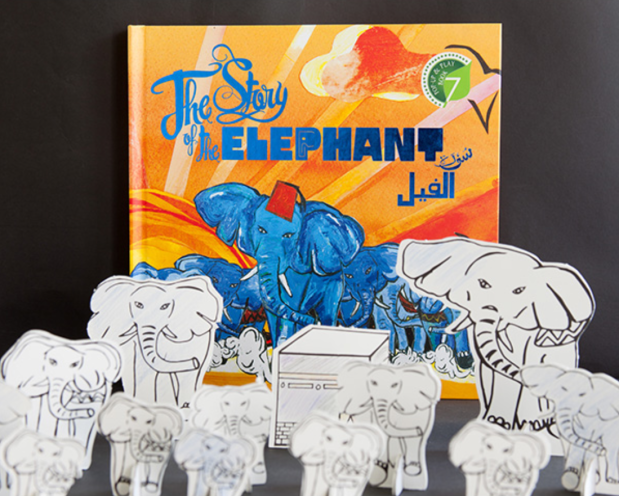
The Story of the Elephant Pop-Up Book
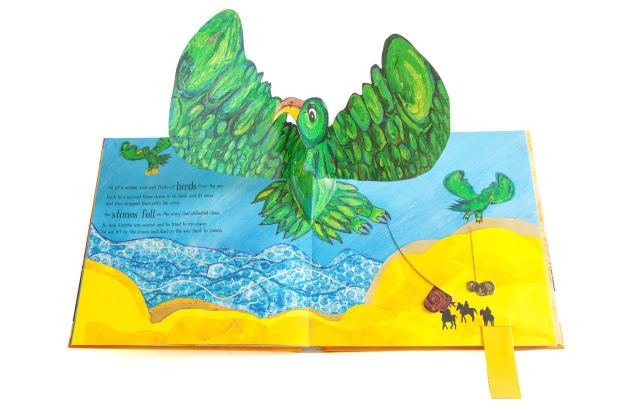
Beautiful water color drawing in every pages
 Muslimah Living In Japan